Keen to perfect uneven teeth or a wonky smile?
Misaligned teeth not only stop us from sharing genuine smiles or speaking and laughing without embarrassment, but they can also affect our ability to bite and chew the foods we love.
Plus, when teeth aren’t correctly aligned, they can create an imbalance in the way facial muscles work – affecting appearance.
In 2025, there are more teeth straightening options available in London than ever before – including traditional fixed braces and removable aligner systems, such as Invisalign treatment, that allow us to straighten our teeth from the comfort of our own homes.
But which is more effective; braces or Invisalign®?
Keep on reading to find out!
What is Invisalign®?
Invisalign® is a discreet, hassle-free, and clinically proven way to straighten teeth.
It involves no wires or brackets. Instead, you’ll need to wear a series of clear, plastic aligners that gradually shift your teeth into the desired position.
These aligners are perfectly tailored to your mouth and existing teeth and trimmed to your gums by your orthodontist to ensure maximum comfort.
Each set is typically worn for 2 weeks before it’s swapped for the next in the series. To ensure your treatment stays on track, you’ll need to wear your nearly invisible braces for at least 20-22 hours per day – only removing them for brushing, flossing, eating, and drinking.

What are the advantages of Invisalign®?
This innovative teeth straightening option can be used to treat various orthodontic conditions, including:
- Overbite
- Underbite
- Open bite
- Gapped teeth
- Overcrowding
Invisalign® treatment isn’t suitable for children, but there is no upper age limit for adults – meaning that, as long as you have good oral health and show no signs of tooth decay or gum disease, you could be an ideal candidate for Invisalign® clear aligners.
Virtually invisible, no one will be able to tell that you’re undergoing orthodontic treatment with Invisalign®. And because they can be removed for eating, drinking and oral hygiene routines, they allow for greater convenience and flexibility in your day-to-day life.
What are fixed braces?
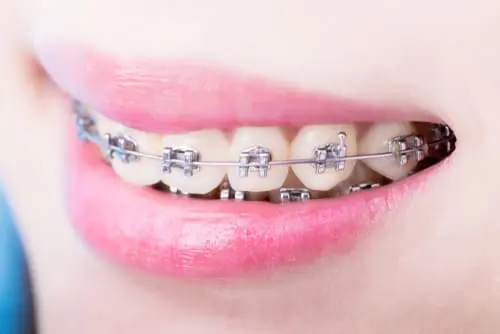
Fixed braces consist of metal brackets that are bonded to your teeth and connected by metal wires, which will be adjusted at regular intervals, usually every 4-6 weeks.
This orthodontic treatment (like Invisalign® and other clear aligner systems) applies the right pressure in the right place to gradually move your teeth into the desired position to achieve a gorgeous, straighter smile.
Unlike Invisalign® where you have to swap to the next set of aligners in the series, fixed braces (sometimes known as “train track braces”) don’t require you to manage any stage of your treatment plan. You simply have your braces fitted, maintain good oral hygiene, and attend your orthodontic appointments for adjustments.
What are the advantages of fixed braces?
This traditional orthodontic treatment is often recommended for people who have complex orthodontic issues, such as:
- Excessive overcrowding
- Deep overbites
- Abnormal tooth eruption
- Significant spacing
Offering precise tooth movement, they deliver predictable and successful results for even the most complicated cases. But that’s not all – fixed braces can be used to treat minor alignment problems, too.
Although traditional metal braces are visible, patients love that they can personalise their brace with different coloured bands at each adjustment appointment, particularly children and teenagers. However, tooth-coloured brackets are available and clear or silver bands can be used for a more discreet look if preferred.
Since metal braces are fixed, you don’t need to remember to wear them or worry about losing them. They work continuously without any disruptions caused by removal for eating or cleaning, ensuring your treatment stays on track.
What is the difference between Invisalign® and fixed braces?
While both are effective treatment options in their own right, they offer several differences.
These include:
- Invisalign® is less noticeable than a fixed brace.
- Invisalign® causes less irritation to the cheeks and gums.
- Fixed braces are permanently bonded to teeth, whereas Invisalign® is removable.
- Fixed braces require careful cleaning around metal brackets and wires.
- Fixed brace wearers are advised to avoid hard, sticky, or chewy foods that could get caught in their brace and damage the metal brackets and wires.
- Invisalign® requires fewer dietary restrictions because they can be removed.
Invisalign® is typically used for mild to moderate cases, while fixed braces are for more severe cases of tooth misalignment.
However, something that sets Kai Dental apart from most other dentists and orthodontists is that Dr Jeet Parekh can use Invisalign for really complex cases.
Should you consider Invisalign® or fixed braces?
Still unsure whether to choose Invisalign® or fixed braces?
Deciding something as important as your dental health and dream smile can be difficult, especially when both options are effective and can achieve similar results – we get it.
That’s why, here at Kai Dental, we assess every patient on a case-by-case basis to determine whether Invisalign® or fixed braces is the most suitable treatment option for your lifestyle, budget, and preferences.
We’ll check your teeth and gums and discuss your smile concerns before creating a bespoke treatment plan.
We’re always honest and transparent about our fees, and our experienced orthodontist in London will let you know what you can expect when you change to the next aligner in the series or have your brace adjusted. Plus, we can offer a better idea of how long you may need to wear your clear aligners or fixed braces.
We also offer Angel Aligners – our own clear aligner system – for patients who prefer a fully removable alternative to both Invisalign® and fixed braces.
To find out more about the teeth straightening options available in-clinic, including for patients seeking a dentist in Marylebone, or to book an initial consultation with our orthodontic specialists, call 020 7229 4033.