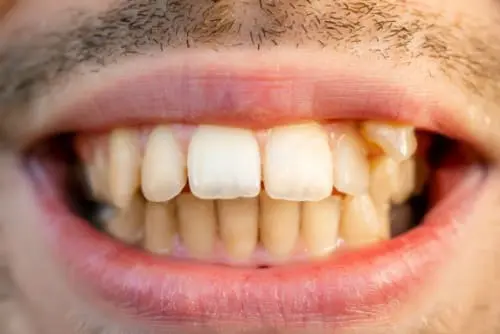
What is an overbite?
A fairly common condition, an overbite is a malocclusion where the upper and lower jaws don’t align correctly. This causes the upper front teeth to overlap the lower set. There are normal overbites, which only cause a slight overlap between 2-4mm, and deep bites, where the front upper teeth cover a significant amount of the lower teeth, usually more than 4-5mm.
Types of overbite
Overbites can be split into two categories: dental and skeletal. Dental overbites are caused by the misalignment of teeth, which can be genetic or a result of habits like tongue thrusting or thumb sucking.
Skeletal overbites are an effect of irregular jawbone structure or development and are a more severe type of malocclusion, often requiring surgery to correct.
Symptoms of an overbite
Here are the signs and symptoms of an overbite:
- Your upper teeth cover at least a third of your lower set when biting down
- Your upper front teeth protrude, or look ‘buck-toothed’
- You have bite problems and find it difficult to chew food
- You suffer from tooth wear
- Gum issues, such as recession behind the teeth
- Speech problems
- Mouth breathing
Why do overbites need to be fixed?
Your oral health, tooth function and appearance should correct your overbite. Fixing this malocclusion can help to prevent:
- Teeth damage
- Protect your gums
- Reduce jaw pain and prevent Temporomandibular Joint (TMJ) disorders
- Improve bite function
- Improve speech
- Better your facial aesthetic and balance
How braces fix an overbite
Typically, overbites are addressed with orthodontic treatment, or jaw surgery may be used for severe skeletal bites. The most effective is fixed braces, which are dental devices used to align teeth, consisting of metal (or ceramic) brackets bonded to the surface of each tooth that are connected with wires.
So, how is an overbite corrected with braces?
Well, braces work by applying pressure to the teeth. Every 6 weeks, the wires are tightened by your orthodontist, which gradually shifts your teeth into new, proper positions over time. In the case of overbites, rubber bands are also added to the brace to pull the upper teeth backwards and the lower teeth forwards.
Length of treatment varies depending on the individual case, but can range between 6-12 months for mild overbites, or 12 months+ for severe ones.
Other orthodontic options include plastic clear aligners, like Invisalign or Angel Aligners. The aligners are replaced every few weeks to shift your teeth into more desirable positions, correcting your overbite over a period of months.